The Redesign of Indonesian
National Lecturer Reporting System
The Redesign of Indonesian National Lecturer Reporting System
Designing clarity and adaptability in the midst of regulatory change
Designing clarity and adaptability in the midst of regulatory change
When Ambiguity Became the Brief
When Ambiguity Became the Brief
Indonesia's Ministry of Education was rewriting performance rules for 270,000 lecturers across 2,600 universities — shifting from rigid point-systems to flexible, growth-oriented evaluation. The regulation was progressive. The problem? It was still being finalized. No technical guide existed. Universities didn't know what "growth-oriented" meant in practice.
Indonesia's Ministry of Education was rewriting performance rules for 270,000 lecturers across 2,600 universities — shifting from rigid point-systems to flexible, growth-oriented evaluation. The regulation was progressive. The problem? It was still being finalized. No technical guide existed. Universities didn't know what "growth-oriented" meant in practice.
The real challenge wasn’t the tight timeline. It was designing for complete ambiguity.
The real challenge wasn’t the tight timeline. It was designing for complete ambiguity.
My Role
I redesigned the national lecturer reporting system, turning new policies into clear workflows and requirements. As the sole designer, I aligned policy, product, and engineering while co-designing and facilitating research.
My Role
I redesigned the national lecturer reporting system, turning new policies into clear workflows and requirements. As the sole designer, I aligned policy, product, and engineering while co-designing and facilitating research.
I made a strategic decision early on:
I made a strategic decision early on:
To design clarity before designing features.
To design clarity before designing features.
Instead of waiting for certainty, I used design to make the regulation tangible,
turning vague text into visual workflows the whole team could align on. So, what did I do?
Instead of waiting for certainty, I used design to make the regulation tangible, turning vague text into visual workflows the whole team could align on. So, what did I do?
01
Design As Alignment Tool
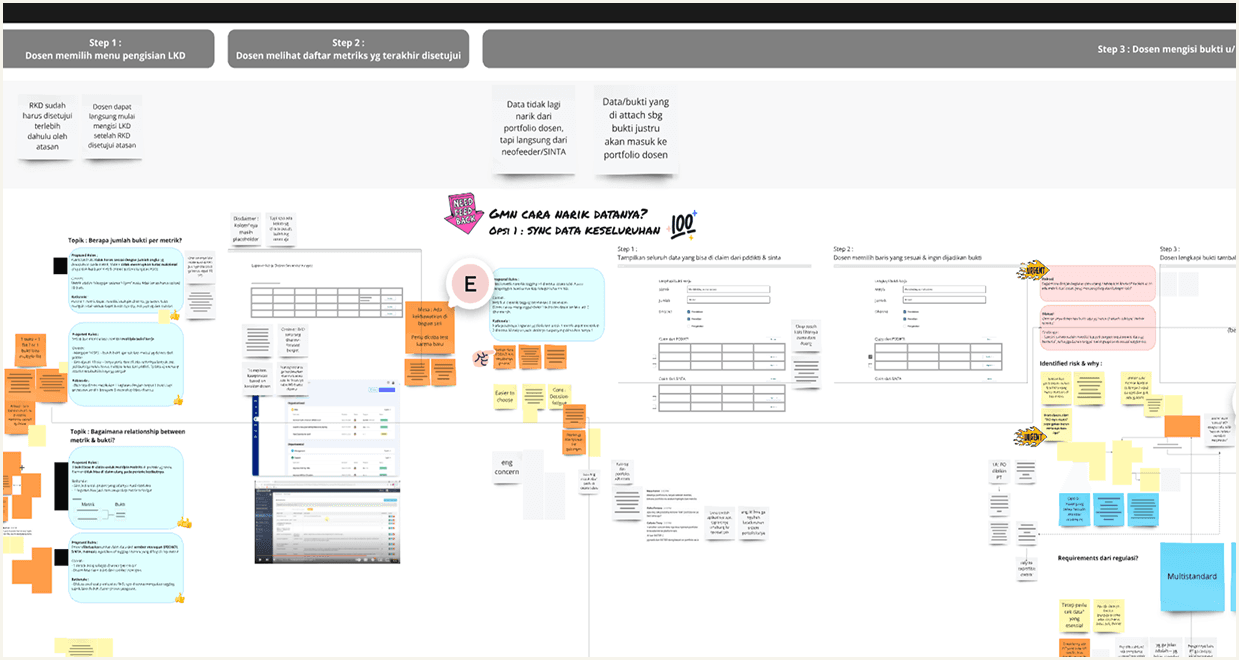
Using regulation drafts, old system data, and prior user studies, I created workflow visualizations mapping every possible scenario. This function as an alignment tools that exposed gaps in policy thinking, not just wireframes.
01
Design As Alignment Tool
Using regulation drafts, old system data, and prior user studies, I created workflow visualizations mapping every possible scenario. This function as an alignment tools that exposed gaps in policy thinking, not just wireframes.
02
Field Research → Real Requirements
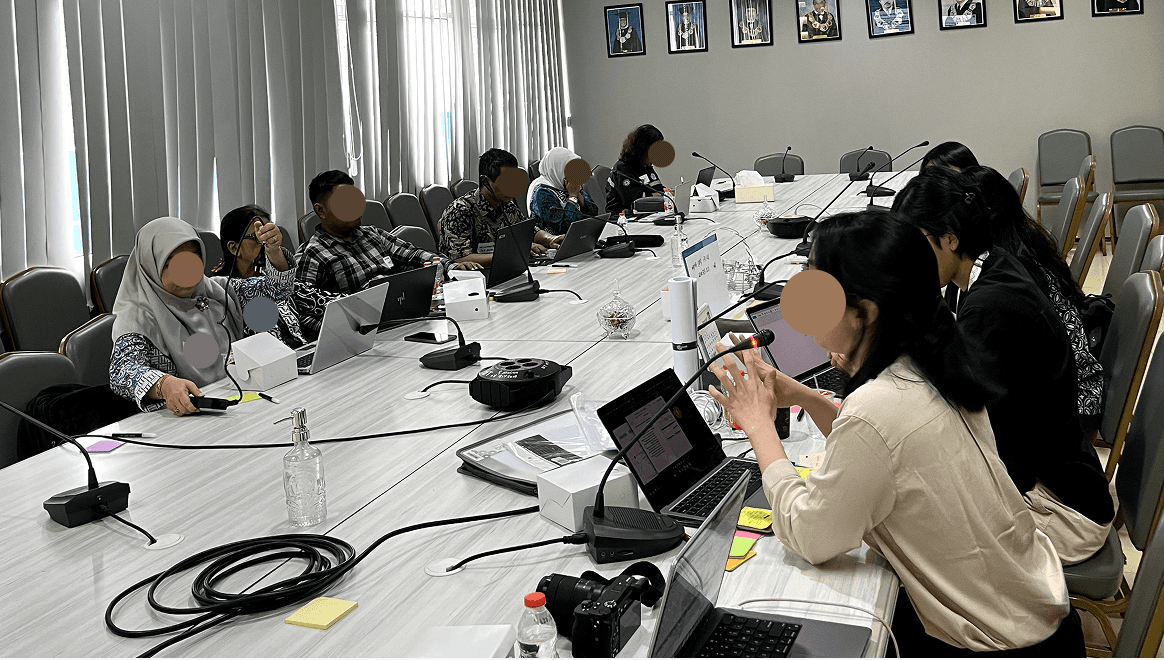
I co-designed visual research tools that turned abstract regulations into into visual prompts, which made it easier for participants to share how they worked, not just what they thought.
02
Field Research → Real Requirements
I co-designed visual research tools that turned abstract regulations into into visual prompts, which made it easier for participants to share how they worked, not just what they thought.
01
Design As Alignment Tool
Using regulation drafts, old system data, and prior user studies, I created workflow visualizations mapping every possible scenario. This function as an alignment tools that exposed gaps in policy thinking, not just wireframes.
02
Field Research → Real Requirements
I co-designed visual research tools that turned abstract regulations into into visual prompts, which made it easier for participants to share how they worked, not just what they thought.
🎯 Design Insight:
🎯 Design Insight:
SISTER shouldn’t just enforce compliance.
It needed to accommodate variation and support realistic reporting workflows.
SISTER shouldn’t just enforce compliance.
It needed to accommodate variation and support realistic reporting workflows.
Designing for Clarity and Adaptability
Designing for Clarity and Adaptability
We consolidated everything we learned, from evolving regulations to real lecturer workflows, into one clear direction: the new system must feel understandable, flexible, and grounded in how lecturers actually work.
We consolidated everything we learned, from evolving regulations to real lecturer workflows, into one clear direction: the new system must feel understandable, flexible, and grounded in how lecturers actually work.
What follows are three core insights and the design responses shaped by them.
What follows are three core insights and the design responses shaped by them.
The Impact
The Impact
Released on October 9, 2024, the new regulation is currently being rolled out to a limited number of universities this year. Here are what they said :
Released on October 9, 2024, the new regulation is currently being rolled out to a limited number of universities this year. Here are what they said :
30% increase in eligible registrations
Streamlined verification flow meant more students could complete their submissions correctly on the first try. It reduced the usual back-and-forth and opened the door for a larger pool of qualified participants.
Lecturer – University in Bogor
30% increase in eligible registrations
Streamlined verification flow meant more students could complete their submissions correctly on the first try. It reduced the usual back-and-forth and opened the door for a larger pool of qualified participants.
Lecturer – University in Bogor
Streamlined and Time-Saving Reporting
"Submitting a report is now very easy because I only need to attach proof of work. This will take me less time than before. Previously, I needed at least a week to complete the report."
Lecturer – University in Bandung
Streamlined and Time-Saving Reporting
"Submitting a report is now very easy because I only need to attach proof of work. This will take me less time than before. Previously, I needed at least a week to complete the report."
Lecturer – University in Bandung
Streamlined and Time-Saving Reporting
"Submitting a report is now very easy because I only need to attach proof of work. This will take me less time than before. Previously, I needed at least a week to complete the report."
Lecturer – University in Bandung
Improved Transparency & Resource Management
"We used to work in silos – as a manager, I often didn’t know what my team was doing until they submitted their reports at the end of the semester. Now we can allocate resources more effectively before the semester begins."
Dean – University in Jakarta
Improved Transparency & Resource Management
"We used to work in silos – as a manager, I often didn’t know what my team was doing until they submitted their reports at the end of the semester. Now we can allocate resources more effectively before the semester begins."
Dean – University in Jakarta
Improved Transparency & Resource Management
"We used to work in silos – as a manager, I often didn’t know what my team was doing until they submitted their reports at the end of the semester. Now we can allocate resources more effectively before the semester begins."
Dean – University in Jakarta
Facilitating Adoption
Facilitating Adoption
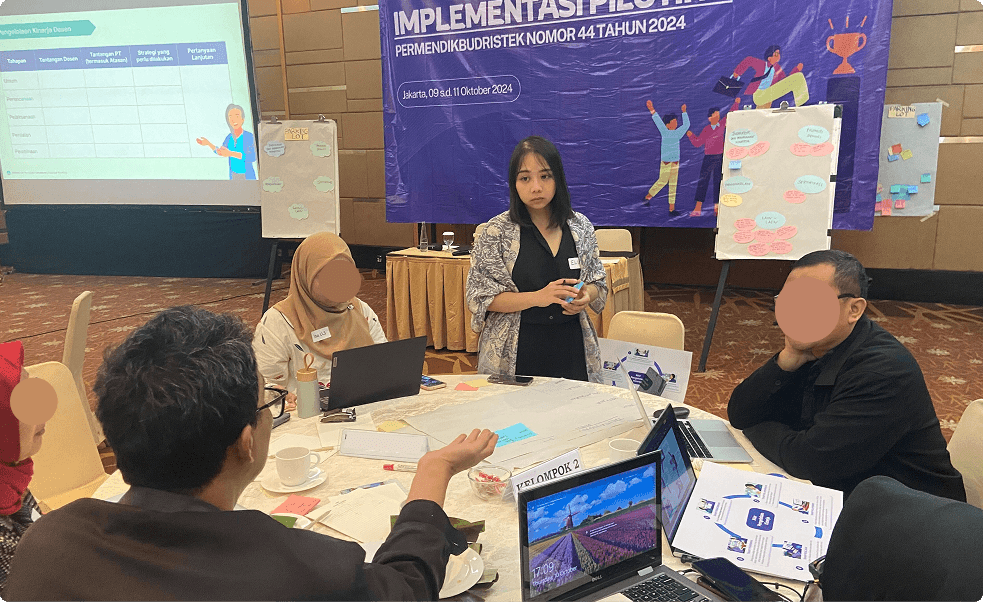
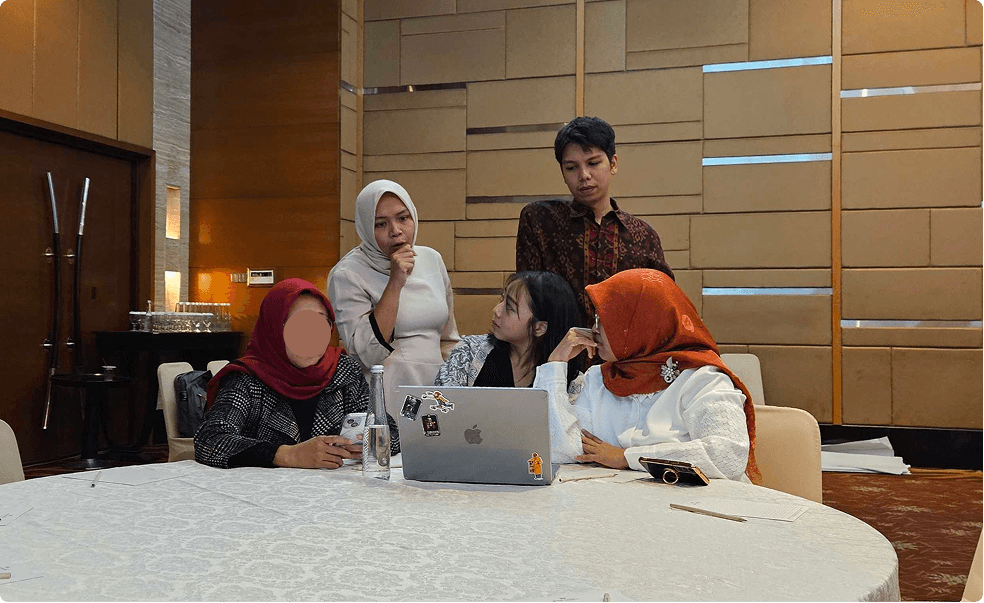
I also took on the role of a facilitator during the socialization workshops for the new regulation, engaging with more than 100 participants, including lecturers, university administrators, and LLDIKTI (Higher Education Service Institution).
I also took on the role of a facilitator during the socialization workshops for the new regulation, engaging with more than 100 participants, including lecturers, university administrators, and LLDIKTI (Higher Education Service Institution).

What I've learned:
Clarity can be designed, even when the rules don’t exist yet.
Design turns evolving policy into a system that understands people, and helps people understand policy.
It’s not only about solving problems, it’s about making sense of them especially when the destination is still being defined.
What I've learned:
Clarity can be designed, even when the rules don’t exist yet.
Design turns evolving policy into a system that understands people, and helps people understand policy. It’s not only about solving problems, it’s about making sense of them especially when the destination is still being defined.
What I've learned:
Clarity can be designed, even when the rules don’t exist yet.
Design turns evolving policy into a system that understands people, and helps people understand policy. It’s not only about solving problems, it’s about making sense of them especially when the destination is still being defined.
Project Details
Project Details
Company
Company
Govtech Edu
Govtech Edu
Year
Year
2024
2024
The Team
The Team
elva
retta

elva
retta